



Most property management companies can’t tell you what it costs to acquire a lease. Not roughly. Not directionally. They genuinely don’t know the number. It’s not tracked in their workflows, it’s not built into most management software, and it’s rarely part of the reporting owners receive. That’s a problem, because multifamily cost per lease is one of the most important metrics in your entire operation, and the few operators who do track it are almost certainly calculating it wrong.
I want to be direct about something. The standard formula most people use, total marketing spend divided by total new leases, gives you a number. But that number is a comfortable lie. It ignores some of the biggest costs associated with acquiring a resident, and it prevents you from making the kinds of strategic decisions that actually move the needle on your property’s financial performance.
After spending over $1 million on digital advertising campaigns and managing over 1,800 multifamily units across Northern Nevada, I’ve developed a more complete framework for understanding what a lease actually costs to acquire. It’s changed how we allocate budgets, evaluate marketing channels, and advise our clients. Let me walk you through it.
Why Most Operators Don’t Know Their Cost Per Lease
Let’s start with the uncomfortable reality. The majority of property management companies don’t track cost per lease at all. It’s not part of their standard reporting, and most property management software doesn’t calculate it automatically. Owners get monthly financials showing marketing as a line item expense, but there’s no connection between what was spent and what it produced.
I’ll give you a real example of how widespread this gap is. We recently brought on a new client who also hired an outside management consultant, someone who had built a reputation in the business, sat on impressive industry boards, and positioned himself as a top-tier advisor. During one of our early conversations, the client asked him what cost per lease he should be targeting. We sat back and let him talk, genuinely curious to hear his perspective. His answer? Around $200. We were stunned. This was someone held up as a pillar in the industry, and his number was off by a factor of ten. It wasn’t even in the right universe. That moment confirmed something I’d suspected for a long time: even at the highest levels of our industry, most people don’t actually understand what it costs to acquire a lease. They’re guessing, and they’re guessing badly.
This is a fundamental gap in how our industry operates. You wouldn’t run a business without knowing your customer acquisition cost, but that’s exactly what most multifamily operators do. They approve a marketing budget, spend it across some combination of ILS listings, paid ads, and maybe some social media, and then evaluate success based on occupancy. If the building is full, the marketing must be working. If it’s not, spend more.
That approach leaves enormous amounts of money on the table. Without knowing your cost per lease, you can’t identify which marketing channels are actually producing results. You can’t make informed decisions about where to increase or decrease spend. And you definitely can’t have an honest conversation about whether your marketing strategy is creating value or destroying it.
The Standard Formula and What It Misses
The operators who do track multifamily cost per lease typically use this formula: Total Marketing Spend / Total New Leases = Cost Per Lease. It’s simple, it’s clean, and it gives you a number you can put on a report. Let’s say you spent $60,000 on marketing last year and signed 50 new leases. That’s a $1,200 cost per lease. Sounds reasonable.
But here’s what that calculation doesn’t include: concessions.
If you offered one month free on those 50 leases at an average rent of $2,000, that’s $100,000 in concession value. Your total acquisition cost isn’t $60,000, it’s $160,000. Your real cost per lease isn’t $1,200, it’s $3,200. That’s a completely different number, and it should lead to completely different strategic decisions.
Concessions Are an Acquisition Cost, Not a Discount
I know why concessions aren’t typically included in cost per lease. They live on a different line item. They’re categorized as a revenue adjustment, not a marketing expense. That’s how the accounting works, and that’s how people have been trained to think about them.
But let me ask you this: what is the purpose of a concession? It’s to get someone to sign a lease. That is, by definition, an acquisition cost. You’re giving away $2,000, $4,000, sometimes more, for the specific purpose of converting a prospect into a resident. That’s no different than spending $2,000 on Google Ads to generate the lead that became that resident. The dollars serve the same function. They just come off different lines on your P&L.
You don’t have to include concessions in your cost per lease calculation. But if you don’t, you’re lying to yourself about what it actually costs to fill a unit.
At Next Level, we include them. We track a “total cost per lease” that captures marketing spend plus concession value, and we track it separately by source. That distinction matters, because it changes how you evaluate your marketing performance entirely.
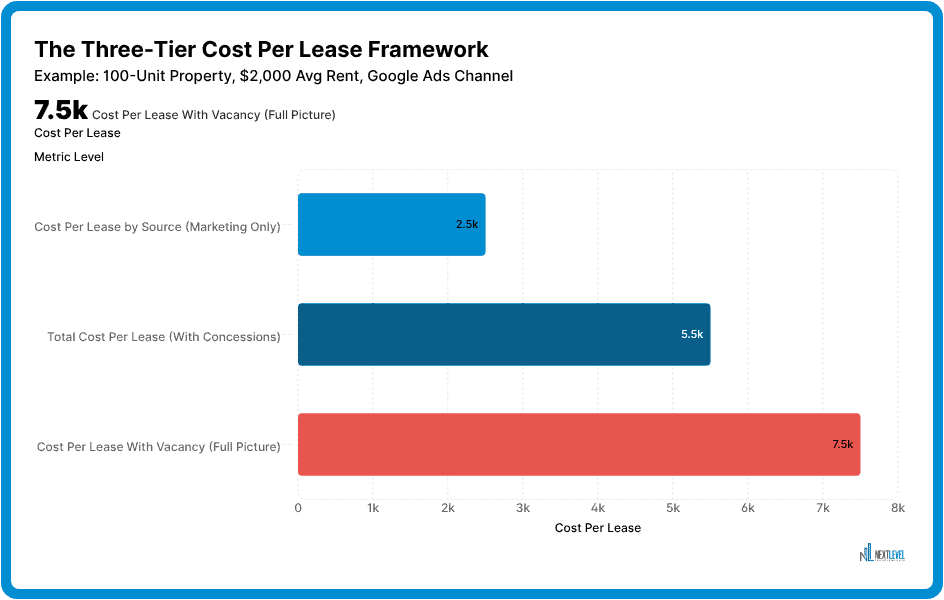
In today’s market, concessions are everywhere. Most operators in our market are offering one to two months free as standard. We’ve even seen concession packages go as high as four to six months free on certain communities here in Reno. When you’re giving away two months of rent on a $2,000 unit, that’s $4,000 in acquisition cost before you’ve spent a single dollar on advertising. On a 100-unit property where you’re turning 40 units a year with two months free on each, that’s $160,000 in concession costs alone. Your marketing budget might be $60,000, but your actual spend to acquire those leases is $220,000. The math is $5,500 per lease, not $1,500.
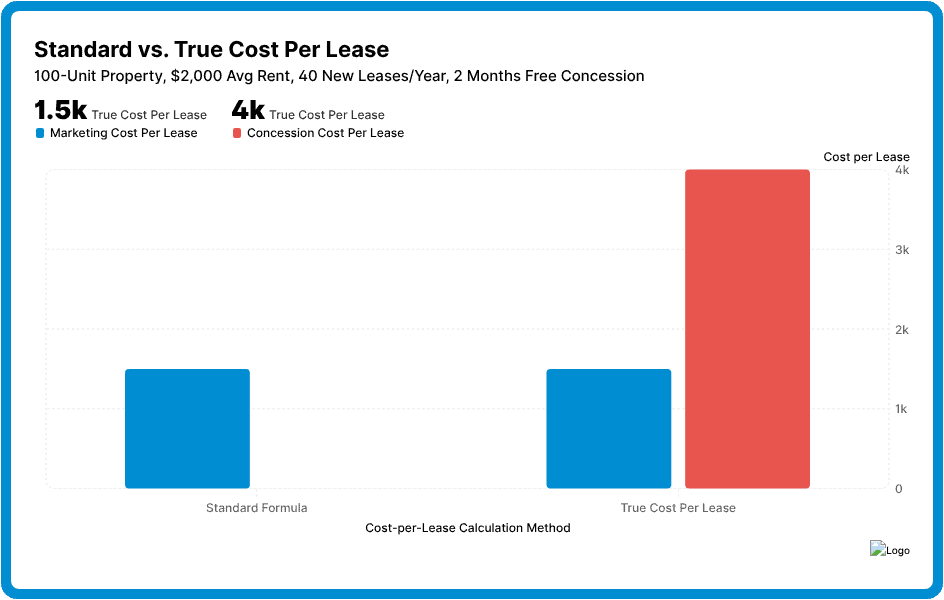
That’s the kind of number that should change how you think about your entire leasing strategy.
Total Cost Per Lease vs. Cost Per Lease by Source
Once you’re tracking the right number at the top level, the next step is breaking it down by source. Your total multifamily cost per lease is useful, but it’s a blended average that hides the performance differences between your individual marketing channels.
Here’s what I mean. Let’s say your total cost per lease (including concessions) is $4,000. That number is the average across every channel: Google Ads, Facebook, ILS listings, SEO, referrals, drive-by traffic, everything. But within that average, the variation is massive. Your Google Ads might be producing leases at $2,500 each while your ILS spend is coming in at $6,000 per lease. Without tracking cost per lease by source, you’d never know that. You’d keep splitting your budget the same way, overspending on underperforming channels and underinvesting in the ones that actually work.
We track cost per lease for every marketing channel we operate. Google Ads, Facebook Ads, organic SEO, each ILS platform, referral programs, all of it. When we can see that one channel is delivering leases at half the cost of another, we shift budget accordingly. That’s not a theory. It’s how we’ve consistently achieved the fastest leasing pace and highest rents in our markets.
The source-level view also helps you understand where concessions are doing the most damage. If your ILS leads are the ones requiring the heaviest concessions to convert while your paid search leads are signing at asking rent, that tells you something important about lead quality and marketing channel effectiveness.
The Vacancy Factor: A Separate But Critical Metric
There’s another cost that most operators overlook: vacancy loss during marketing lag. Every day a unit sits empty between one resident moving out and the next lease starting, you’re losing revenue. On a $2,000/month unit, a 30-day vacancy gap costs you roughly $2,000. A 45-day gap costs $3,000.
I wouldn’t necessarily fold vacancy loss into your standard cost per lease formula, because it introduces variables that go beyond marketing (turnover timing, maintenance speed, notice periods). But I do think you should track a “cost per lease with vacancy” metric alongside your standard number. It gives you a more complete picture of what resident turnover actually costs, and it makes a strong case for investing in marketing strategies that reduce time-to-lease.
When you see that your total cost to replace a resident, including marketing, concessions, and vacancy loss, is $6,000 or $7,000, it reframes every conversation about retention, renewal strategy, and proactive marketing spend. Suddenly, spending an extra $500 per unit on marketing to reduce your vacancy window by two weeks looks like a bargain.
Not All Leases Are Created Equal
Here’s one more layer that matters: lease quality. A lease that results in an early termination, a skip, or a non-renewal at month 12 effectively doubles your acquisition cost because you’re paying to fill that unit all over again. If you signed 50 leases this year but 15 of those residents didn’t renew (or worse, broke their lease early), your effective cost per lease is much higher than the number on paper.
This is where screening quality and marketing targeting intersect with financial performance. Better marketing doesn’t just mean more leads. It means better leads, prospects who are genuinely qualified, who can afford the rent without concessions, and who are likely to stay. When your marketing attracts the right residents, your renewal rates go up, your turnover costs go down, and your true cost per lease drops significantly over time.
How This Changes Your Marketing Strategy
When you start tracking multifamily cost per lease the right way, with concessions included and broken down by source, it transforms how you make decisions.
First, it justifies smarter marketing investment. If your true cost per lease is $5,000 and you can reduce that to $3,500 by spending more on targeted digital advertising that generates higher-quality leads requiring fewer concessions, the ROI is obvious. You’re not spending more on marketing. You’re spending less on leasing.
Second, it gives you leverage to reduce or eliminate concessions. When you can demonstrate that strong demand generation fills units without giveaways, the conversation with ownership shifts from “everyone’s offering concessions” to “our marketing produces enough demand that we don’t have to.” That’s a fundamentally different competitive position, and it flows directly to NOI and property value.
Third, it creates accountability. When every marketing dollar is tracked to a lease outcome, there’s no room for “we think it’s working.” You know exactly what’s working, what isn’t, and where to shift resources.
We actually just launched a five-part multifamily marketing series on the Next Level Property Management podcast where we dig deeper into these concepts, including how we structure our marketing budgets and track performance across channels. If this topic resonates with you, I’d encourage you to check that out.
What Smart Operators Are Doing Differently
The operators who are winning in today’s market aren’t the ones with the biggest marketing budgets. They’re the ones who understand what every lease actually costs to acquire and make decisions based on that complete picture.
At Next Level, we approach this by tracking three numbers for every property we manage. First, cost per lease by source, which tells us where to allocate budget. Second, total cost per lease including concessions, which tells us the real acquisition cost. And third, cost per lease with vacancy, which tells us the full financial impact of turnover.
These aren’t complicated metrics to calculate. But they require intentionality, the right tracking systems, and a willingness to look at numbers that might be uncomfortable. Most management companies avoid this level of transparency because the numbers reveal inefficiencies they’d rather not confront.
If you don’t know your cost per lease right now, that’s the first problem to solve. And if you do know it but you’re not including concessions in the calculation, I’d challenge you to run the math with concessions included. The gap between those two numbers is the gap between what you think your marketing is costing you and what it’s actually costing you. Close that gap, and you’ll start making decisions that create real value for your asset.