


Property reserve funds are one of those topics that generate tension in almost every owner conversation I have. Owners see money sitting in an account that could be generating returns elsewhere. Property managers see protection against the inevitable major repairs that will come. Residents don’t think about reserves at all until something breaks and repairs take too long. I’ve been on all sides of these conversations over my 17 years in Northern Nevada real estate, and I can tell you that underfunded reserves create problems that ripple through every stakeholder relationship.
The challenge is that property reserve funds often feel abstract until you need them. When your HVAC system fails in July or your roof starts leaking during winter storms, suddenly those reserves become very concrete. The properties I’ve managed that maintained adequate reserves navigated these crises smoothly. The ones that didn’t? Those situations were painful for everyone involved.
Let me walk you through why reserve funding matters, how properties end up with shortfalls, and what happens when reserves run dry. More importantly, I’ll share the framework I use to help owners understand reserve planning as risk management rather than dead capital.
Understanding Property Reserve Funds and Their Purpose
Property reserve funds are separate accounts designated for capital expenditures and major repairs. They’re distinct from operating budgets, which cover day-to-day expenses like payroll, utilities, and routine maintenance. Reserves exist for the expenses you know are coming but can’t predict exactly when: roof replacements, parking lot resurfacing, HVAC system replacements, elevator modernization, plumbing system overhauls.
Most owners intellectually understand this distinction, but emotionally, reserves feel like money that’s not working. I get it. When you’re looking at $200,000 sitting in a reserve account while you’re evaluating another acquisition opportunity, it’s tempting to view those reserves as available capital. But that $200,000 isn’t available. It’s already allocated to future known expenses.
“The properties I’ve managed that treated reserves as truly separate accounts, untouchable except for their designated purpose, consistently outperformed those that viewed reserves as flexible capital.”
In my experience serving on government advisory boards and working with properties across different ownership structures, I’ve learned that reserve discipline separates professional operators from those who struggle during inevitable capital events. This isn’t theory. It’s what I’ve seen play out repeatedly across the Northern Nevada market.
The Multiple Stakeholder Impact of Underfunded Property Reserve Funds
Reserve shortfalls affect everyone connected to a property, though not always in ways that are immediately visible. Let me share what I’ve seen from different perspectives.
Owners face unexpected capital calls when reserves can’t cover major repairs. If you’re part of an ownership group, you know how difficult these emergency funding requests can be. Someone is always cash-constrained or frustrated that “proper planning” should have prevented this situation. I’ve mediated these conversations, and they’re never pleasant. Even when everyone eventually contributes, the trust and goodwill in the ownership group takes a hit.
Residents experience the most visible impact through deferred maintenance. When property reserve funds are inadequate, management has to prioritize which repairs happen and which get delayed. That might mean living with a pool that stays closed an extra season, common area carpets that should have been replaced two years ago, or parking lot potholes that keep getting worse. Residents don’t know about reserve shortfalls. They just know their property isn’t being maintained to the standard they expect.
“Reserve shortfalls affect everyone connected to a property, though not always in ways that are immediately visible. Residents don’t know about reserve shortfalls. They just know their property isn’t being maintained to the standard they expect.”
Property managers get caught in the middle. We’re the ones explaining to residents why repairs are delayed while simultaneously explaining to owners why we need emergency funding. We’re managing vendor relationships when we can’t pay invoices on time because we’re waiting for capital contributions. We’re watching online reviews deteriorate as resident satisfaction drops. The operational stress of managing with inadequate reserves affects every aspect of our work.
Lenders whose properties serve as collateral have a stake in reserve adequacy too. Many loan agreements include reserve requirements for exactly this reason. A property with deferred maintenance and inadequate reserves represents increased risk. I’ve seen refinancing attempts complicated by reserve shortfalls that raised red flags during lender due diligence.
The complexity is that these impacts aren’t always immediate. You can operate with inadequate property reserve funds for a while, especially if you’re lucky with timing. But eventually, major systems fail. When they do, the lack of reserves creates problems that damage relationships across all these stakeholder groups.
How Properties End Up With Underfunded Reserve Funds
Understanding how reserve shortfalls happen helps prevent them. In my experience, properties rarely start out planning to underfund reserves. It happens through a combination of optimism, pressure, and circumstances.
The most common path is optimistic initial budgeting. When properties are acquired or developed, reserve contributions get established based on reserve studies or pro forma assumptions. These numbers often reflect best-case scenarios: systems lasting their full expected life, repairs costing less than worst-case estimates, no unexpected failures. Reality rarely cooperates with best-case planning. Systems fail early. Repairs cost more than projected. Unexpected issues emerge.
Cash flow pressures lead to deferred reserve contributions. When a property faces occupancy challenges or unexpected operating expenses, reserve contributions become tempting targets for short-term relief. Owners think, “We’ll catch up next quarter when occupancy improves.” But next quarter brings its own pressures. Before you know it, you’re two years behind on reserve contributions and facing a major roof repair with inadequate funds.
I’ve also seen properties where reserves were never properly established to begin with. This happens more often with newer owners or properties that changed hands without adequate due diligence on capital planning. The previous owner might have been planning to sell before major capital expenses hit. The new owner inherited a property without the reserve cushion needed to manage upcoming capital needs.
Large unexpected expenses can drain even adequate reserves. A major plumbing failure that requires replacing risers throughout a building, storm damage beyond insurance coverage, code compliance upgrades mandated by local jurisdictions. These events happen. When they do, previously adequate reserves can suddenly become insufficient for remaining capital needs.
The real challenge is that property reserve funds compete with other financial priorities. Owners look at cash flow and see multiple demands: debt service, desired returns, other investment opportunities, building operating cushions for vacancies. Reserve contributions feel less urgent than these immediate pressures. That’s understandable from a business perspective, but it creates risk that eventually manifests as crisis rather than planned expenditure.
The Cascading Consequences of Reserve Shortfalls
Let me walk you through what actually happens when property reserve funds run short. These aren’t abstract risks. These are situations I’ve navigated and watched other properties struggle through.
The immediate consequence is emergency capital calls. When a major system fails and reserves are inadequate, owners must come up with cash quickly. This creates stress even for well-capitalized owners, and it can create real hardship for owners who are cash-constrained. I’ve been in meetings where these calls fractured ownership groups. Some partners could contribute immediately. Others couldn’t or wouldn’t. The resulting tension damaged relationships that had been strong for years.
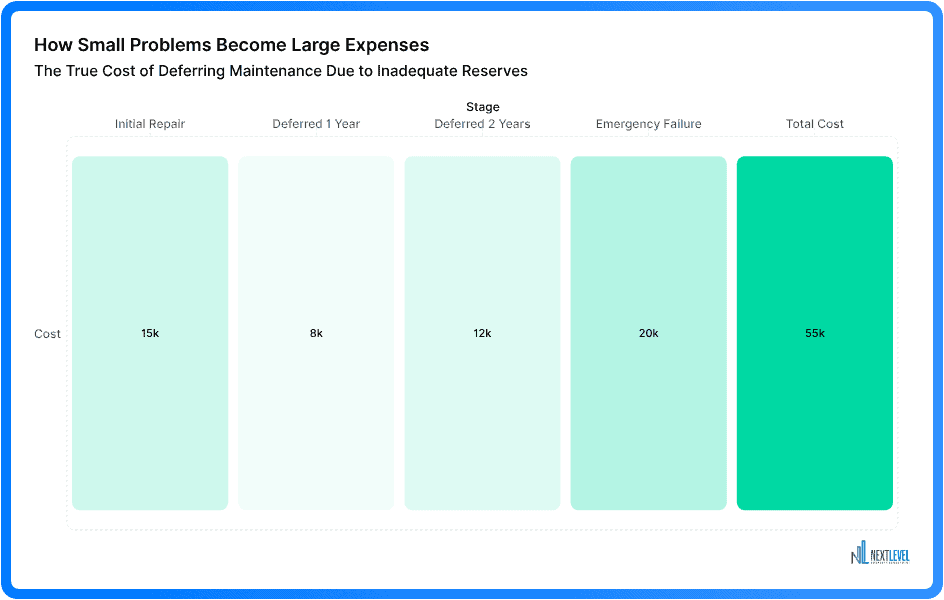
“When you can’t afford to address issues promptly, small problems become large problems. A roof that needs partial repair eventually needs full replacement.”
Deferred maintenance accelerates deterioration. When you can’t afford to address issues promptly, small problems become large problems. A roof that needs partial repair eventually needs full replacement. HVAC systems that should have been replaced start failing more frequently, increasing emergency repair costs and resident complaints. Parking lots that needed resurfacing develop structural issues requiring more extensive (and expensive) work.
When Emergency Systems Fail
Critical system failures without adequate reserves create genuine crises. I managed a property where the main water line failed during winter. With adequate reserves, we would have hired the contractor immediately and completed repairs within a week. Without reserves, we had to negotiate payment terms with contractors, which delayed the work while we arranged emergency funding. Residents dealt with water disruptions for nearly two weeks instead of one. The frustration and negative reviews that resulted took months to overcome.
HVAC failures in extreme weather aren’t just inconvenient. They’re potentially dangerous for vulnerable residents and create liability concerns. Elevator failures in multi-story buildings affect accessibility and fair housing compliance. These aren’t scenarios you can simply defer until funding becomes available. You find a way to make repairs happen, but without property reserve funds, you’re operating in crisis mode rather than executing planned maintenance.
The Impact on Property Reputation and Resident Retention
Residents don’t know or care about reserve funding levels. They care that their property is well-maintained and management is responsive. When deferred maintenance becomes visible, resident satisfaction drops. That shows up in online reviews, which affect your ability to attract quality prospects. It shows up in renewal rates, as residents look for better-maintained alternatives. It shows up in rent growth potential, as you can’t justify premium pricing when your property shows deferred maintenance.
I’ve watched properties lose their competitive positioning in the market because reserve shortfalls led to visible decline. These weren’t poorly managed properties. They were properties where financial constraints forced difficult decisions about what maintenance to defer. Those decisions, rational in the moment, created long-term consequences that reduced property value and owner returns.
The reputation damage extends beyond current residents. Property management companies develop reputations based on the portfolio they manage. When we’re associated with properties showing deferred maintenance due to reserve shortfalls, it affects our ability to win new business. Vendors become hesitant to work with properties known for payment delays. The ripple effects touch everyone involved.
Building and Maintaining Adequate Property Reserve Funds
Proper reserve planning starts with realistic assessment and consistent funding. Here’s the framework I use to help owners establish and maintain adequate property reserve funds.
The foundation is a comprehensive reserve study. This isn’t a document you commission once and file away. A proper reserve study identifies all major building components, estimates their remaining useful life, projects replacement costs, and recommends funding levels to ensure adequate reserves when each component needs replacement or major repair. Good reserve studies are updated every three to five years to reflect actual deterioration rates, cost changes, and any major repairs or replacements that have occurred.
The Reserve Study Process
When I commission reserve studies for properties I manage, I look for engineers who actually walk the property and inspect systems rather than relying solely on age and document review. The difference in quality is substantial. An engineer who inspects your HVAC systems might identify issues that suggest replacement in five years rather than the ten years suggested by age alone. That information lets you plan funding accordingly rather than being surprised by premature failure.
“A proper reserve study isn’t a document you commission once and file away. It’s a planning tool that should drive strategic decisions about capital expenditures and funding priorities.”
The reserve study should provide multiple funding scenarios. Level funding (consistent contributions over time) works well for stabilized properties. Straight-line funding (contributions that increase over time) can work for properties with younger systems where major expenses are further out. Cash flow funding (variable contributions based on when expenses are expected) provides flexibility but requires discipline to actually make larger contributions in heavy expenditure years.
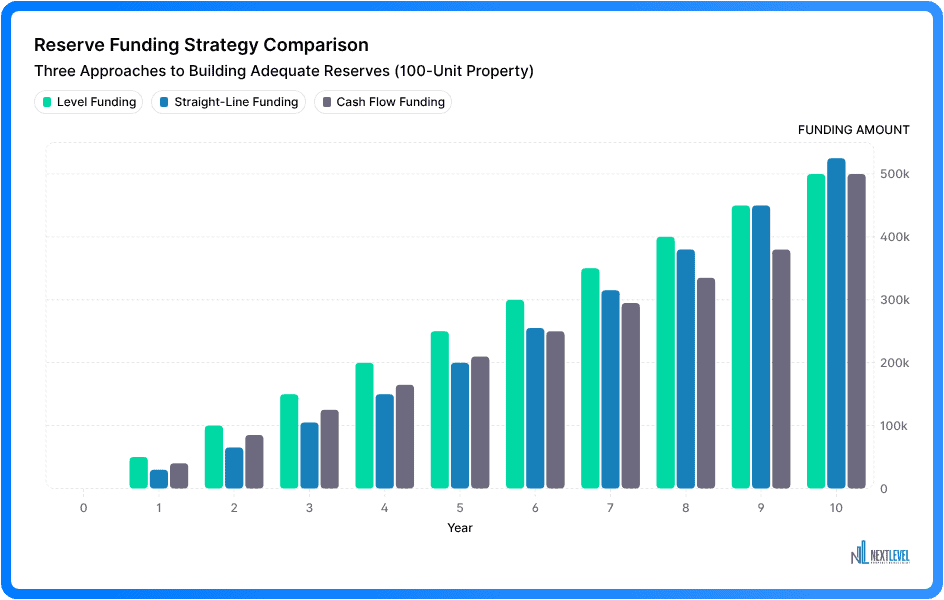
Use the reserve study as a planning tool. When I review reserve studies with owners, we don’t just look at the bottom-line funding recommendation. We examine the timing of major expenses, identify opportunities to coordinate projects for efficiency, and discuss which systems might benefit from proactive replacement before failure. This collaborative approach helps owners see property reserve funds as strategic asset management rather than just an expense line item.
Balancing Reserve Funding with Cash Flow Realities
I’m pragmatic about reserve funding. Textbook recommendations assume you can fully fund reserves from day one. Real-world operations require balancing ideal funding with cash flow realities, especially when you’re starting from a deficit position.
If you’re taking over a property with inadequate reserves, don’t try to catch up overnight. That creates unsustainable cash flow strain and increases the temptation to skip contributions when other pressures emerge. Instead, develop a multi-year plan that gradually builds reserves while maintaining operational stability. You might start by funding 70% of the ideal contribution and increasing by 10% annually until you reach full funding. This approach is sustainable and demonstrates commitment to proper reserve management.
Prioritize funding for systems most likely to fail soon or whose failure creates the greatest operational impact. If your reserve study indicates your roof has eight years of remaining life but your HVAC systems are showing signs of impending failure, weight your reserve allocations accordingly. You’re not ignoring the roof, but you’re being strategic about where limited dollars go first.
Build reserve contributions into your budget as non-negotiable line items, not as discretionary funding that gets allocated only if cash flow allows. When property reserve funds are treated as optional, they get deferred during any cash flow pressure. When they’re budgeted as essential, you find other ways to manage when pressures emerge.
Navigating Reserve Discussions With Owners
The most difficult aspect of property reserve funds isn’t the technical planning. It’s the conversations with owners about funding levels and the discipline required to maintain adequate reserves.
I frame these conversations around risk management rather than optimal financial planning. Owners understand risk. When I explain that inadequate reserves mean we’re betting that no major systems fail in the next three years, that’s a concrete risk they can evaluate. When I show them what happened to comparable properties that faced major repairs without reserves, the abstract becomes tangible.
I also acknowledge the opportunity cost of reserve funding honestly. I don’t pretend that money sitting in reserves generates the same returns as that capital deployed elsewhere. But I explain that the “return” on adequate reserves is avoiding the much higher costs of emergency repairs, deferred maintenance, resident dissatisfaction, and property value decline. It’s insurance, not investment.
When ownership groups have differing perspectives on reserve funding, I facilitate conversations that get everyone on the same page about risk tolerance. Some owners are more conservative and want higher reserves. Others are comfortable with lower reserves and higher risk of capital calls. These are legitimate differences in investment philosophy. The key is reaching agreement on what level of risk the group collectively accepts and then funding reserves consistently to that agreed level.
I’ve also learned to document these conversations carefully. When ownership groups decide to underfund reserves relative to study recommendations, I ensure that decision is documented with acknowledgment of the risks involved. This isn’t about covering myself. It’s about ensuring everyone makes informed decisions and remembers what was agreed to when circumstances change later.
Regulatory and Lender Considerations
Beyond internal stakeholder dynamics, property reserve funds often face external requirements that affect how they must be managed.
Lenders typically require minimum reserve balances as part of loan agreements. These requirements exist because lenders understand that inadequate reserves threaten the value of their collateral. I’ve seen properties face technical loan defaults not because they missed debt service payments but because their reserves fell below required minimums. That’s a conversation no owner wants to have with their lender.
Properties with FHA-insured mortgages or HUD financing face specific reserve requirements that must be met. These aren’t suggestions. They’re regulatory requirements with compliance monitoring. During my time on the Nevada Real Estate Division Advisory Committee, I saw how seriously state and federal regulators view reserve adequacy for properties under their oversight.
Even without specific regulatory requirements, reserve adequacy affects your position during inspections or compliance reviews. Local code enforcement officials look more favorably on properties with clear capital planning and adequate reserves than on properties showing deferred maintenance due to funding constraints. It signals professional management and reduces concerns about whether building systems are being properly maintained.
From a liability perspective, boards and owners have fiduciary responsibilities to maintain properties properly. While this applies most directly to HOA and condo situations, the principle extends to multifamily properties. Underfunding reserves to the point where it creates unsafe conditions or regulatory violations can create liability exposure. I’m not a lawyer, but I’ve seen enough situations to know that “we couldn’t afford it” doesn’t eliminate legal responsibility for property conditions.
The Long-Term Value Perspective
After 17 years managing properties throughout Northern Nevada, I’ve learned that adequate property reserve funds are one of the clearest indicators of long-term property performance. Properties with consistently funded reserves maintain their competitive position, preserve resident satisfaction, avoid emergency capital calls, and position themselves strongly for refinancing or sale.
The properties that struggle are rarely struggling because of bad luck with systems or timing. They’re struggling because inadequate reserves forced deferred maintenance, which created operational problems, which hurt financial performance, which made adequate reserve funding even more difficult. It’s a cycle that’s hard to break once it starts.
The solution isn’t complicated. Commission proper reserve studies. Fund reserves consistently at levels recommended by those studies. Treat reserves as untouchable except for their designated purpose. Communicate regularly with owners about reserve status and upcoming capital needs. These aren’t revolutionary concepts. They’re basic professional property management practices that protect everyone’s interests.
If you’re evaluating a property management company or assessing your current management’s performance, reserve planning and discipline should be part of that evaluation. Ask to see the reserve study. Ask how consistently reserves have been funded relative to study recommendations. Ask about the process for updating reserve plans as systems age or circumstances change. The answers will tell you a lot about whether your property is positioned for long-term success or setting up for future problems.
At Next Level Property Management, we build reserve planning into every comprehensive approach to protecting asset value and maintaining stakeholder relationships. We’ve seen too many properties struggle because reserves were treated as an afterthought rather than a fundamental component of financial planning. That’s not how we operate, and it’s not how properties under our management will be positioned. Our focus on operating expense management and comprehensive financial planning ensures that reserve adequacy is prioritized from day one.