


Last month, Zillow announced an exclusive partnership with EliseAI that will embed AI chatbots directly into rental listings on their platform. Property owners advertising on Zillow will soon have every prospect inquiry filtered through artificial intelligence before ever reaching a human. The announcement was framed as innovation, a way to “simplify communication” and “deliver faster responses.” But here’s what they didn’t say: you’re about to lose direct control of your most expensive leads.
This isn’t just a Zillow problem. It’s a symptom of what we’re seeing across the entire multifamily property management AI landscape as adoption explodes. After managing multifamily communities and equipping them with advanced digital marketing strategies for more than a decade, I’m watching a dangerous pattern unfold. Property management companies are racing to implement AI without understanding the difference between strategic deployment and value destruction. The gap in multifamily property management AI implementation between those who get it right and those who don’t isn’t just widening, it’s starting to show up in asset values.
I’m not here to argue against AI. I use it extensively in our operations at Next Level Property Management, and when deployed strategically, it’s extraordinarily powerful. But I recently had an owner send me financial projections they’d generated using ChatGPT. The analysis was completely wrong, contradicted fundamental best practices, and would have led to disastrous investment decisions. They didn’t know enough to recognize the garbage output they were getting from garbage input. That’s when I realized we need to have a different conversation about AI in multifamily.
This article will help you understand the three tiers of AI implementation I’m seeing in the industry, identify whether your property management company is using AI to increase or unknowingly destroy asset value, and recognize what strategic AI deployment actually looks like when expertise and technology work together.
The Multifamily Property Management AI Implementation Crisis
The Explosion of AI Adoption (And Why Speed Doesn’t Equal Strategy)
The numbers tell a clear story. According to AppFolio’s latest Property Management Benchmark Report, 28% of property managers now use AI in some capacity, up from just 14% the previous year. That’s a 100% increase in twelve months. At Apartmentalize 2025, AI dominated every conversation. Industry leaders cited impressive aggregate data showing seven fewer days from lead to move-in, a 15% increase in retention rates, and teams saving up to 10 hours per employee per week.
These numbers sound transformative, and for some operators, they are. But here’s what those statistics hide: massive variation in how AI is actually being implemented. The same technology producing breakthrough results for strategic operators is simultaneously destroying value for others who rushed to “check the AI box” without thinking through the implications.
I see this firsthand when talking with other property managers and owners. Companies are adopting AI tools at breakneck speed, driven by fear of falling behind and vendor promises of easy efficiency gains. What they’re not doing is asking the fundamental question that should precede every technology decision: how does this create or protect asset value?
The difference between adopting AI tools and implementing AI strategy is the difference between owning a hammer and knowing how to build a house. Right now, the industry is full of people swinging hammers without blueprints, and the owners are the ones who will pay for the structural damage.
Why Most AI Implementations Fall Into Three Categories
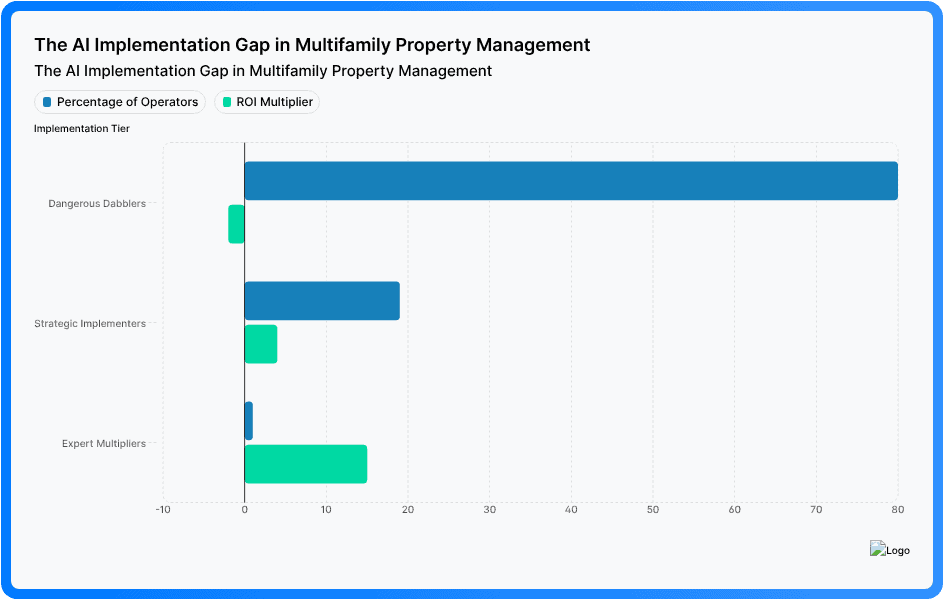
After watching AI adoption unfold across hundreds of properties and dozens of management companies, I’ve observed that multifamily property management AI implementations generally fall into three distinct categories. This isn’t about technological sophistication or budget size. It’s about strategic alignment with the fundamental goal of property management: maximizing asset value.
The first category I call Dangerous Dabblers. These are operators using AI in ways that actively destroy value, often without realizing it. They’re eliminating human touchpoints that drive premium rents, making financial decisions based on flawed AI analysis, or creating resident experiences that accelerate turnover. The technology works as designed, but the deployment strategy is fundamentally misaligned with asset performance.
The second category is Strategic Implementers. These operators have moved beyond superficial applications and are using AI to drive measurable operational improvements. They’re deploying predictive maintenance systems, optimizing revenue management with human oversight, and automating routine tasks to free their teams for relationship work. This is where real impact starts. They’re seeing the efficiency gains and ROI improvements the industry talks about.
The third category, which represents perhaps 1% of operators, is what I call Expert Multipliers. These are firms that had deep operational expertise before AI existed and are now using the technology to amplify that knowledge exponentially. They understand that AI is a multiplier, not a replacement. Their decade of financial experience, their portfolio-level pattern recognition, their deep market knowledge gets amplified by AI’s computational power and speed. The result isn’t incremental improvement but competitive advantage that compounds over time.
The multifamily industry has spent decades building relationships between on-site teams and residents. Companies implementing AI to eliminate those touchpoints aren’t innovating—they’re dismantling the foundation of resident retention.
Where most companies land matters more than you might think. The gap between these categories is already showing up in occupancy rates, renewal percentages, and ultimately, cap rates. Let me show you what each looks like in practice.
Dangerous Dabblers: When AI Actively Destroys Value
The Chatbot Problem: Eliminating Human Touch on Your Most Expensive Leads
Picture this scenario, which I’ve now heard variations of from multiple owners. Your marketing efforts over a busy weekend generate 100 qualified leads. These aren’t tire-kickers browsing Zillow at 2am, these are high-intent prospects actively searching for their next apartment. By Monday morning, half of those leads have already booked tours at competing properties. Your leasing team arrives to find a queue of chatbot transcripts but very few scheduled appointments.
What happened? The industry’s solution to the “instant gratification” problem was to deploy AI chatbots that respond 24/7 to every inquiry. On the surface, this makes sense. Research shows you lose 50% of potential leads if you take longer than 90 minutes to respond. For a 100-unit Class A community spending $25-35 per unit annually on marketing (which represents good, strategic marketing), that’s $2,500 to $3,500 invested to generate leads. When you lose half of them due to delayed response or poor AI handling, you’re essentially throwing away $1,250 to $1,750 in marketing spend every single month.
But here’s what that solution misses: not all touchpoints are created equal. A prospect who’s actively comparing properties, ready to make a decision, asking specific questions about lease terms or move-in specials, that’s a high-value lead worth hundreds of dollars in marketing investment. These high-value prospects need more than instant automated responses. They need rapport, they need someone who can handle nuanced objections, they need to feel like this community actually wants them as a resident.
I’ve reviewed chatbot transcripts from multiple properties, and the pattern is consistent. The AI handles basic questions fine, can they have a dog, what utilities are included, is there guest parking. But the moment a prospect asks something that requires judgment, “I have two cats but one is an emotional support animal, will that work?” or “Your pricing shows $2,200 but I saw $2,150 on Apartments.com, which is correct?” the conversation stalls or worse, the AI provides incorrect information that kills the lead entirely.
The Zillow and EliseAI integration amplifies this problem exponentially. Now your most expensive lead source, the platform where prospects are actively comparison shopping, will filter every inquiry through a third-party AI before that lead ever reaches your team. You’re paying premium dollars for leads you may never actually have a human conversation with. The AI will schedule tours, but it won’t build the relationship that makes someone choose your property over the identical floor plan across the street.
At Next Level Property Management, we took a different approach. We use AI for after-hours response and routine inquiries, but during business hours, if you call or message us directly, you’re going to speak with a person. We implemented AI strategically as overflow support, not as a replacement for human interaction on high-value leads. That’s the difference between using technology to enhance service versus using it to eliminate the human touchpoints that actually drive conversions.
The false economy of replacing humans with chatbots on expensive leads shows up in conversion rates. You might save some operational costs by running a leaner leasing team, but if your conversion rate drops from 15% to 8% because AI can’t build rapport and handle objections the way humans can, you’ve destroyed far more value than you’ve saved. Do that math across a 100-unit community and you’ve cost the owner substantial NOI, not to mention the long-term impact on average rent achieved and property valuation.
The “Garbage In, Garbage Out” Financial Analysis Disaster
I mentioned the owner who sent me ChatGPT-generated financial projections. Let me give you the specific example because it illustrates a problem I’m seeing with increasing frequency.
This owner uploaded their property’s historical financials into ChatGPT and asked it to analyze potential value-add opportunities. The AI came back with an elaborate analysis suggesting they could increase NOI by $180,000 annually through a combination of rent increases and expense reductions. The owner was excited, ready to move forward with the strategy.
When I reviewed the analysis, I found multiple fundamental errors. The AI had suggested raising rents 18% immediately across all units because “the market could support it based on comparable properties.” But it hadn’t accounted for lease renewal timing, existing lease terms, or the fact that pushing rents that aggressively would spike vacancy and tank resident retention. It suggested cutting property management fees by 40% because they were “above market average,” without understanding that our area has higher labor costs and that those fees covered 24/7 emergency response and hands-on maintenance coordination that lower-fee companies don’t provide. It projected a massive insurance savings by switching carriers, but didn’t understand that the quote it found online was for a completely different coverage structure.
If that owner had followed the AI’s recommendations, they would have created a disaster. Resident turnover would have spiked, vacancy would have climbed, and the insurance gap would have left them massively exposed. The projected $180,000 NOI increase would have turned into a $200,000 loss.
Here’s the thing: the AI didn’t malfunction. It did exactly what it was designed to do, which is pattern-match against its training data and generate an output that sounds authoritative. The problem is that the owner lacked the expertise to structure the prompt properly, provide the right context, and most critically, recognize which parts of the output were nonsensical.
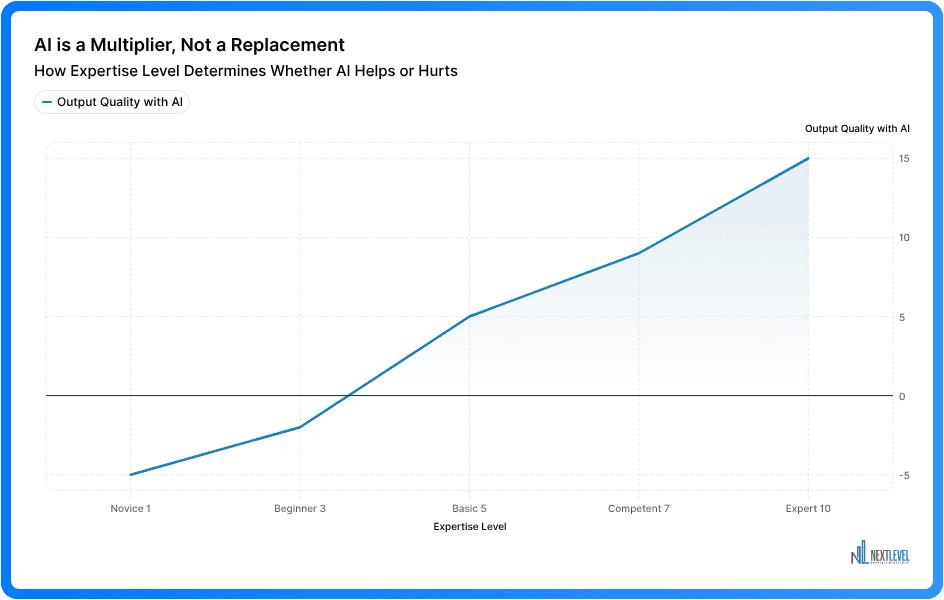
AI is a multiplier, not a replacement. If you’re a 10 out of 10 expert, AI makes you a 15 out of 10. If you’re a 3 out of 10 novice, AI makes you a negative 2 out of 10. The technology amplifies whatever expertise you bring to it—which is why the foundation has to be deep industry knowledge, not just access to ChatGPT.
I’m seeing this same pattern with owners using AI to analyze due diligence documents, evaluate property acquisitions, and build investment projections. The technology is extraordinarily powerful for these applications, but only if you already understand what you’re looking at. Without the foundational expertise, you’re not using AI as a tool, you’re using it as a Ouija board and making million-dollar decisions based on whatever answer it happens to give you.
Residents Can’t Reach Humans When It Matters
The third major problem I’m seeing is property management companies routing all resident communications through AI with limited or no human escalation paths. This shows up most obviously in maintenance requests and billing issues, the two areas where residents most need actual problem-solving help.
One property I consulted for had implemented an AI system that handled all maintenance requests. Residents submitted requests through an app, the AI assessed the issue based on the description, automatically scheduled a technician, and sent updates. It worked beautifully for straightforward requests like changing air filters or fixing a leaky faucet. But when a resident reported “water stains on my ceiling,” the AI scheduled a painter. The actual problem was a roof leak that required immediate attention to prevent major damage. By the time a human looked at the situation, the damage had spread to multiple units.
Another property routed all resident calls through an AI phone system. Residents calling about late fees, lease questions, or community issues talked to a bot that could access their account information and provide scripted responses. The problem emerged when a resident called about a domestic violence situation in the neighboring unit. The AI directed them to “submit a noise complaint through the resident portal.” The resident, frustrated and frightened, moved out at the end of her lease and left a scathing review that tanked the property’s online reputation for months.
These aren’t edge cases. They’re predictable outcomes of eliminating human judgment from complex situations. When residents can’t reach a person who can actually solve their problem, they don’t blame the AI, they blame the property. That shows up in reduced renewal rates, negative reviews, and ultimately, lower valuations.
Strategic Implementers: Where AI Impact Becomes Real
Predictive Maintenance: Preventing Problems Before They Cost You
This is where I start seeing AI implementations that actually make sense from an asset value perspective. Strategic operators are using AI to analyze sensor data from HVAC systems, water heaters, and other major equipment to predict failures before they happen. The AI monitors usage patterns, temperature fluctuations, energy consumption, and performance metrics, then flags equipment that’s trending toward failure.
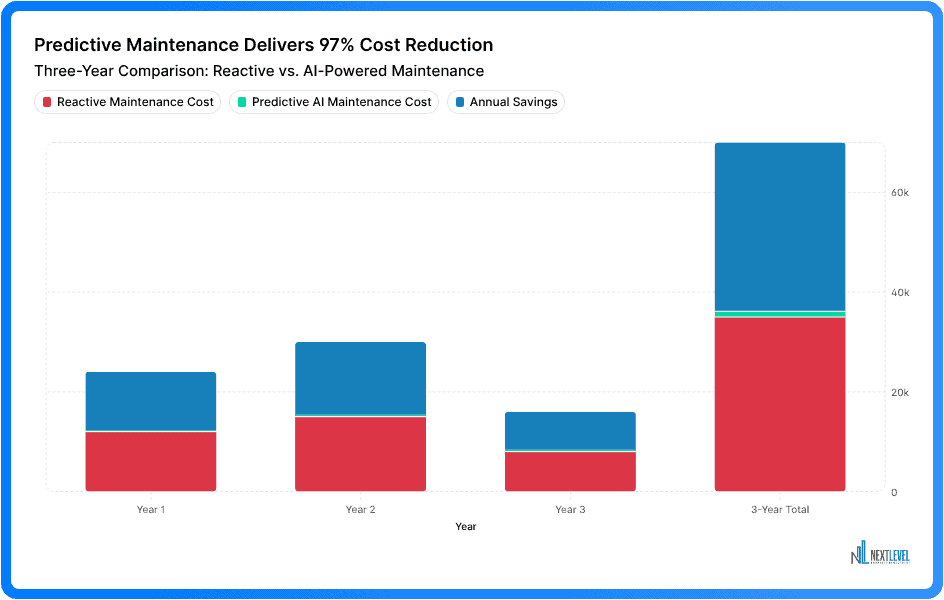
One property we work with installed smart sensors on their HVAC units and connected them to a predictive maintenance platform. The system analyzes data from all units in real-time, comparing performance against historical baselines. Three months in, the AI flagged a rooftop unit that was operating within normal parameters but showing subtle efficiency degradation. A technician inspected it and found a refrigerant leak that would have caused complete failure within weeks. By catching it early, they replaced a $300 part instead of a $12,000 unit, and avoided the resident complaints and emergency overtime charges that come with HVAC failure in the middle of summer.
The strategic difference here is obvious. The AI handles routine monitoring, something it’s extraordinarily good at. It can track thousands of data points across dozens of systems simultaneously, something no human maintenance team could practically do. But humans make the intervention decisions. A technician reviews the AI’s flagged items, applies judgment about timing and priority, and schedules the actual work. The AI amplifies the maintenance team’s effectiveness but doesn’t replace their expertise.
Across a 100-unit community, this approach typically extends equipment life by 20-30%, reduces emergency repair costs by 40%, and significantly improves resident satisfaction by preventing the failures that generate the most complaints. That translates directly to NOI through lower operating expenses and higher retention rates.
Revenue Management: Data-Driven Pricing With Expert Oversight
Revenue management is another area where strategic AI implementation drives measurable results. These systems analyze market trends, competitor pricing, historical leasing velocity, seasonal patterns, and dozens of other variables to recommend optimal rent pricing and renewal offers. Bristol Development Group, a regional multifamily developer, reported achieving approximately $100 per unit in incremental revenue during lease-up phases by using AI-powered revenue management.
I use similar tools in our operations, but here’s the critical distinction: the AI provides recommendations, not decisions. When our revenue management system suggests a rent increase or renewal offer, I review it against our local market knowledge, the specific unit’s condition, the resident’s payment history, and the broader portfolio strategy. Sometimes I override the AI’s recommendation because I know something the algorithm doesn’t, like upcoming supply delivery in the submarket or a resident who’s been a model tenant for five years and deserves consideration beyond what the numbers suggest.
The companies getting this wrong treat the AI recommendations as gospel. The algorithm says raise rent by $150, so they raise it by $150. They don’t question whether that increase makes sense for a resident facing financial hardship who’s been consistently on time with payments for two years. The result is that resident moves out, you incur turnover costs, and you lose the stability that high-quality long-term residents provide. You “won” on the rent increase but lost on asset performance.
Strategic revenue management with AI isn’t about maximizing every transaction. It’s about optimizing portfolio performance over time. The AI gives you data-driven pricing ranges. Your expertise tells you where in that range to actually land based on context the algorithm can’t see.
Lead Qualification and Routing (Done Right)
Several companies I’ve talked with are using AI for lead qualification in ways that make strategic sense. The AI pre-screens incoming inquiries, asks qualifying questions about move-in timeline, budget, and requirements, then routes high-intent prospects to leasing teams for immediate follow-up while nurturing longer-term leads through automated campaigns.
The key is that this AI application treats the technology as a triage tool, not a replacement for the sales process. High-value prospects get human attention quickly. The AI handles the initial sorting so leasing teams can focus their time on the conversations most likely to convert. Lower-intent leads get kept warm through automated touchpoints until they’re ready for human interaction.
This is completely different from the chatbot implementation I criticized earlier. Instead of filtering expensive leads through AI to save payroll, this approach uses AI to maximize the effectiveness of human leasing professionals. They’re not taking fewer calls, they’re taking better calls. The conversion rate on leads that reach leasing agents goes up because the AI has already qualified intent and gathered basic information.
One property using this approach saw their leasing team’s conversion rate increase from 12% to 19% over six months, not because the team got better at selling but because they were spending their time with prospects who were actually ready to lease. That’s strategic AI deployment aligned with asset performance.
Operational Efficiency: Freeing Teams for Relationship Work
The most successful AI implementations I’ve seen focus on automating truly administrative tasks so human team members can focus on work that requires judgment, relationship building, and problem-solving. This includes things like data entry, routine reporting, scheduling, basic resident communications about rent payments or move-in procedures, and document processing.
When a leasing agent doesn’t have to spend 30 minutes manually entering application data into five different systems because AI extracts and populates that information automatically, they can spend those 30 minutes building rapport with prospective residents or following up with leads. When a property manager doesn’t have to compile manual reports pulling data from multiple sources because AI generates those reports overnight, they can spend that time on proactive resident retention strategies or property improvement planning.
This is the vision some companies have started describing as role evolution. Instead of “leasing agents,” you have “community engagement specialists” focused on relationship building. Instead of “assistant managers” doing administrative work, you have “resident experience managers” focused on satisfaction and retention. The work that felt robotic and repetitive gets automated, and humans focus on the aspects of property management that actually require human capabilities.
Strategic AI implementation doesn’t reduce headcount—it redirects human expertise toward the work that actually drives NOI: building relationships, solving complex problems, and creating communities residents choose to stay in.
Expert Multipliers: How the 1% Use AI to Create Exponential Value
Financial Modeling and Projections: When Expertise Meets AI
This is where AI becomes exponentially powerful, but only if deep expertise comes first. Before AI existed, financial modeling meant hours in Excel building formulas, running scenarios, stress-testing assumptions, and producing projections. That expertise, those hundreds of hours learning how cap rates actually work, how debt service affects returns, how market shifts impact valuations, that’s the foundation that makes AI useful rather than dangerous.
Now when I need to analyze acquisition opportunities or build proformas for owner clients, I can use AI to run dozens of scenarios in the time it used to take me to build one. I can stress-test assumptions across multiple variables simultaneously. I can model cap rate compression scenarios across different exit timelines, compare debt structures with varying interest rate environments, and analyze cash-on-cash returns under different occupancy and rent growth assumptions.
But here’s why the expertise prerequisite matters: I know which questions to ask. I know how to structure prompts that give me useful analysis rather than garbage. I can immediately spot when an AI output doesn’t make sense because the logic contradicts financial fundamentals. I know which variables matter most and which are noise.
When that owner sent me their ChatGPT financial analysis, the difference wasn’t that I had access to better AI. I was using the same tools they were. The difference was 10 years of financial experience that taught me how to interpret the output, which recommendations to trust, and which to reject. But equally important, that expertise taught me how to prompt the AI properly in the first place. I knew what context to provide, which assumptions to specify, what questions to ask, and how to structure the prompt to get accurate, useful analysis rather than plausible-sounding nonsense.
This is the Expert Multiplier effect. If you’re already a 10 out of 10 at financial modeling, AI makes you a 15 out of 10. You’re not just faster, you’re capable of analysis that wasn’t practical before. If you’re a 3 out of 10 novice, AI makes you a negative 2 out of 10 because you lack the expertise to use it properly.
For sophisticated investors evaluating property management companies, this distinction matters enormously. Ask your PM company about their financial expertise, not just their AI tools. Anyone can buy software. Deep financial acumen combined with AI tools is what actually drives asset optimization.
Due Diligence Analysis: Portfolio-Level Intelligence
Another area where expertise combined with AI creates exponential value is property due diligence. When analyzing acquisition opportunities, I’m now using AI to process rent rolls, operating statements, and market data at a speed that wasn’t possible manually. But the AI isn’t making decisions, it’s surfacing patterns that my portfolio-level experience then interprets.
For example, I can feed historical financial statements into AI and ask it to identify anomalies or concerning trends. It will flag things like unusual expense spikes, declining rent growth, or occupancy patterns that deviate from market norms. But I’m the one who determines whether those anomalies matter. Maybe that expense spike was a one-time roof replacement that actually enhances value. Maybe that occupancy dip coincided with a major employer relocation that’s since been replaced. The AI surfaces the patterns, my experience across 1,800+ units tells me which ones are red flags and which are explainable.
I’ve also started using AI to analyze property condition reports and inspection documents. I can upload a 100-page inspection report and ask the AI to categorize findings by urgency, estimate replacement costs, and identify items that could affect insurance or financing. That initial processing saves hours, but I still review every flagged item because I know which issues are deal-breakers and which are routine maintenance that any property will have.
The strategic advantage here isn’t just speed. It’s the ability to analyze more opportunities in greater depth than competitors who are either doing everything manually or trusting AI outputs without the expertise to validate them. When deal flow is high, the operator who can quickly but accurately assess opportunities wins. That requires expertise and AI working together.
Strategic Decision Support: Building Custom AI Systems
This is where the 1% starts to separate even further from everyone else. The most sophisticated operators aren’t just using off-the-shelf AI tools, they’re building custom AI systems trained on their specific portfolio data, market knowledge, and operational playbooks.
The cutting edge of this approach involves creating what amounts to a board of AI advisors, each trained in different aspects of operations. Imagine a “board member” that specializes in financial analysis, another in market trends, another in resident retention strategies, another in maintenance planning. These AI systems would interact with each other, debate recommendations, and surface insights that no single AI tool could provide.
Here’s how this could work in practice: when evaluating whether to implement a renovation program, you’d have an AI trained on your historical leasing data analyzing how renovations would affect absorption and rent premiums. Simultaneously, another AI trained on your maintenance records would estimate ongoing cost changes from the improvements. A third AI trained on market data would assess competitive positioning and timing considerations. These specialized AI systems would provide analysis from their different perspectives, and together they’d offer insights far more sophisticated than what any single tool could deliver.
This level of implementation requires serious technical expertise and significant investment in training the AI systems on proprietary data. It’s not accessible to most operators yet, which is precisely why it represents the next frontier of competitive advantage. When your AI systems have been trained on millions of data points from your actual portfolio performance, they can provide insights that generic AI tools simply can’t match.
The key insight here is that even these sophisticated systems require human oversight. The AI board would provide recommendations, but experienced operators would make the final decisions. The technology amplifies expertise but doesn’t replace judgment. This is the natural evolution of the Expert Multiplier approach, where deep operational knowledge combined with increasingly powerful AI tools creates exponential competitive advantage.
Preserving Human Touch Where It Drives Premium Value
One of the most strategic decisions Expert Multipliers make is where not to automate. They’ve carefully identified which touchpoints justify premium positioning and preserved human interaction there, even when AI automation would be technically possible.
For high-end properties targeting sophisticated renters willing to pay premium rents, the leasing experience is part of the product. These properties don’t route prospects through chatbots. They have experienced leasing professionals who build rapport, understand nuanced needs, and can articulate the lifestyle and community experience in ways no AI can replicate. The efficiency gains from automation aren’t worth the conversion rate loss on premium units.
Similarly, strategic operators preserve human touchpoints for complex resident issues, renewal negotiations for long-term residents, and community relationship building. These interactions drive retention and justify premium pricing. Automating them saves money but destroys value.
The strategic question isn’t “what can we automate?” It’s “where does automation enhance value and where does it diminish value?” Expert Multipliers have thought carefully about this distinction and implemented AI accordingly. They automate ruthlessly in areas where AI improves efficiency without affecting resident experience, but preserve and even enhance human interaction where it drives premium value.
The result is operational efficiency without sacrificing the relationships that differentiate their properties from competitors. They achieve both lower operating costs and higher resident satisfaction, and that combination drives superior NOI and asset values.

How to Evaluate Your Property Management Company’s Multifamily AI Strategy
Red Flags That Indicate Dangerous Implementation
If you own multifamily assets and want to evaluate whether your property management company is using AI strategically or destructively, here are the warning signs to watch for.
First, can your prospects reach a human for high-value inquiries? If someone wants to tour a unit, has a complex leasing question, or is trying to understand pricing and availability, are they talking to a person or going through multiple levels of AI before maybe reaching someone? Companies that filter expensive leads through automation are prioritizing efficiency over conversion, and you’re paying for it in lost leases.
Second, can your residents reach a human when they need one? I’m not talking about 2am maintenance emergencies, automated after-hours response makes sense. I’m talking about daytime calls about billing issues, lease questions, or complex maintenance problems. If residents are complaining they can’t get a real person on the phone, that’s destroying resident satisfaction and increasing turnover risk.
Third, how does your PM company talk about AI? If they’re focused on “replacing staff” or “reducing headcount” through AI, that’s a red flag. Strategic operators talk about AI enabling staff to focus on higher-value work. If the primary goal is cutting payroll rather than optimizing performance, that should concern you.
Fourth, can they explain how AI decisions are made and validated? If you ask how their revenue management system works or how they verify AI-generated financial analysis, do they give you a clear answer or do they treat it as a black box? Companies using AI strategically can explain their validation processes. Companies using it dangerously often can’t.
Fifth, are they providing generic responses that could apply to any property? If your PM company is using AI to handle resident communications and you’re seeing templated, generic responses that don’t reflect your specific property or community culture, that’s a sign they’ve prioritized automation over quality.
Finally, do they have demonstrated expertise in the areas where they’re deploying AI? If they’re using AI for financial analysis, what’s their team’s financial background? If they’re using AI for marketing optimization, what’s their actual marketing expertise? AI amplifies whatever knowledge you bring to it. If the underlying expertise is thin, the AI outputs will be unreliable.
Green Flags of Strategic Implementation
On the other hand, strategic AI implementation has clear indicators you can look for.
First, they can clearly articulate where AI adds value and where humans lead. They’ve thought carefully about which functions benefit from automation and which require human judgment. They can explain the logic behind their AI deployment decisions and how it aligns with asset performance goals.
Second, they have demonstrated expertise in the areas where AI is being deployed. If they’re using AI for financial modeling, they have team members with serious accounting and financial analysis backgrounds. If they’re using AI for operational efficiency, they have deep operational experience that informs how they structure and validate AI outputs.
Third, human oversight and validation are built into AI processes. They’re not treating AI recommendations as automatic decisions. There are checkpoints where experienced team members review outputs, validate recommendations, and apply judgment before taking action.
Fourth, they’ve preserved human touchpoints on high-value interactions. Prospect tours, renewal negotiations, complex resident issues, these interactions are still human-led. They’re using AI to enhance efficiency in areas that don’t affect resident experience, not automating away the relationships that drive retention.
Fifth, they can point to measurable ROI tied to specific AI implementations. They’re tracking metrics like occupancy rates, renewal percentages, operating expense ratios, and resident satisfaction scores, and they can show you how AI deployment has moved those numbers.
Finally, they’re transparent about AI limitations and failure modes. They acknowledge that AI makes mistakes, they have processes to catch and correct those mistakes, and they’re honest about situations where AI isn’t appropriate. That transparency indicates they understand the technology rather than just marketing it.
Questions to Ask Your Property Management Company
When evaluating your PM company’s AI strategy, here are specific questions that will reveal whether they’re strategic operators or dangerous dabblers.
How are you using AI in leasing, and at what point do prospects speak to humans? Listen for whether high-intent prospects get immediate human attention or whether all inquiries are filtered through automation first.
What expertise informs your AI implementations? Ask about their team’s background in finance, operations, marketing, whatever areas they’re using AI in. Deep expertise should precede AI deployment.
How do you validate AI outputs before taking action? Listen for specific processes, not vague assurances. Strategic operators can describe their validation workflows in detail.
Which resident interactions remain human-led, and why? This question reveals their thinking about where human touchpoints matter. You want to hear thoughtful answers about relationship building and value drivers, not justifications for maximum automation.
What measurable impact has AI had on occupancy, renewal rates, and NOI? Ask for specific numbers tied to specific implementations. Vague claims about efficiency or innovation aren’t enough, you want data.
How do you handle situations where AI provides incorrect information? This reveals whether they’ve thought about failure modes and built appropriate safeguards. Strategic operators have clear escalation paths when AI gets things wrong.
What’s your strategy for maintaining the human relationships that drive premium positioning? This is especially important for higher-end properties. You want to hear about intentional preservation of human touchpoints that justify premium rents, not blanket automation.
The quality of answers to these questions will tell you quickly whether your PM company understands strategic AI deployment or whether they’re just implementing tools because everyone else is.
The Future of Multifamily Property Management AI: Strategic Advantage or Competitive Disadvantage
The Widening Gap Between Strategic and Superficial Operators
The data on AI adoption shows a concerning pattern. According to recent industry research, 47% of firms managing 5,000+ units are using AI compared to just 28% of firms managing fewer than 50 units.
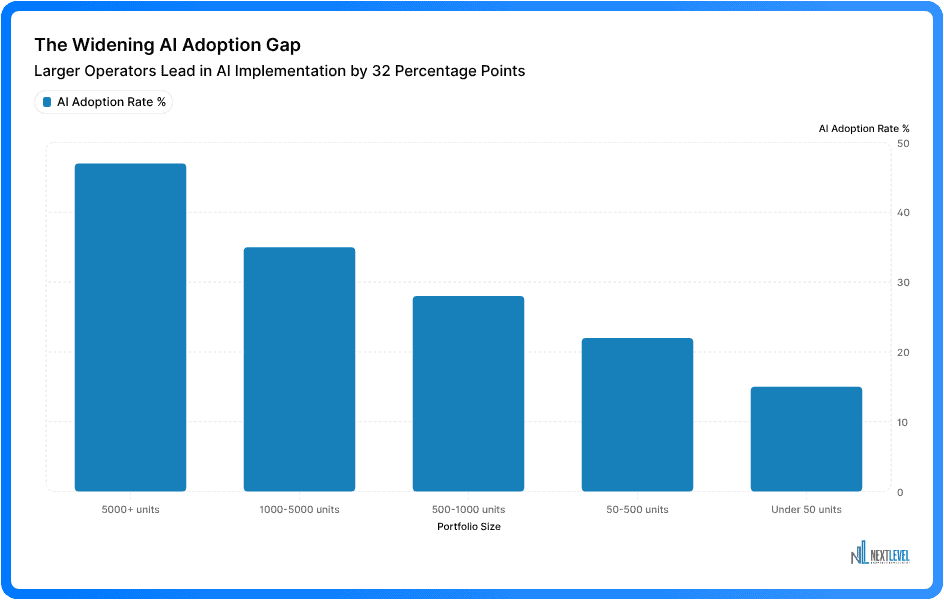
The initial interpretation might be that larger operators have more resources to invest in technology, which is partially true. But that’s not the full story.
What’s actually happening is that strategic sophistication is creating competitive advantage that compounds over time. Companies that implement AI strategically are achieving better operational efficiency, higher resident satisfaction, and improved financial performance. That success generates resources to invest in even more sophisticated implementations. Companies that implement AI superficially or destructively are seeing marginal benefits at best and value destruction at worst, which limits their ability to compete over time.
One industry observer put it this way: “The fast will eat the slow, but the slow will die very slowly.” Real estate adopts technology gradually, so the competitive disadvantage from poor AI strategy won’t show up overnight. But it’s coming. Properties with strategic AI implementations are achieving higher occupancy rates, better renewal percentages, and premium rents. That performance gap will widen as AI capabilities expand.
The critical insight is that the divide isn’t really about size. Boutique operators with deep expertise can absolutely compete against large-scale implementations that lack strategic thinking. The gap is between operators who treat AI as a strategic tool that amplifies human expertise versus those who treat it as a cost-cutting mechanism or a marketing checkbox. Expertise plus strategic AI deployment beats shallow AI adoption at any scale.
The ILS Platform Control Problem
The Zillow and EliseAI integration I mentioned at the start represents a broader industry trend that should concern every property owner. Internet listing services are implementing AI layers that sit between prospects and properties, which fundamentally changes the prospect relationship.
When a prospect searches for apartments on Zillow and interacts with an AI chatbot embedded in the listing, who owns that relationship? Not the property. The ILS platform controls the experience, determines what information gets shared and how, and decides when and if a human from the property gets involved. You’re paying premium advertising rates for leads you never directly engage with until they’ve already been filtered through someone else’s AI.
This matters because brand differentiation and relationship building happen in those early interactions. When AI homogenizes the experience across all properties on a platform, your ability to differentiate based on service quality or community culture gets limited. You’re competing primarily on price and photos, which drives down margins and increases resident price sensitivity.
The strategic response isn’t to abandon ILS platforms, they’re still significant lead sources. The response is to own the prospect experience through superior direct marketing and engagement strategies. Properties that build strong brands, generate direct traffic through SEO and content marketing, and create superior prospect experiences will be less dependent on third-party platforms and their embedded AI layers. That’s another area where marketing expertise combined with strategic technology creates competitive advantage.
What’s Coming: Agentic AI and Deeper Automation
The next wave of AI development will involve what the industry calls agentic AI, systems that don’t just respond to requests but proactively manage complex workflows. Instead of a chatbot that answers questions, you’ll have AI agents that coordinate entire processes. Move-in coordination agents that handle everything from lease signing to utility setup to maintenance readiness. Renewal agents that proactively reach out to residents months before lease expiration, analyze their satisfaction data, and make personalized retention offers. Maintenance agents that don’t just schedule repairs but manage vendor relationships, track work quality, and optimize service delivery.
This technology will create even greater potential for both value creation and value destruction. In the hands of strategic operators with deep expertise, agentic AI will enable sophisticated workflow optimization that wasn’t previously possible. In the hands of operators without that expertise, it will automate bad processes at scale and destroy resident relationships faster than ever before.
The expertise requirements won’t decrease as AI capabilities expand, they’ll increase. The operators who’ve built strong foundations of operational excellence, financial acumen, and resident relationship management will be positioned to leverage increasingly powerful AI tools. Operators who’ve been using AI as a band-aid over weak fundamentals will find themselves further behind.
Positioning for Success in an AI-Augmented Industry
If you’re a property owner or investor trying to position for success in an increasingly AI-augmented industry, the strategy is clearer now than it might have seemed at the start of this article.
First, prioritize operators with deep expertise in the fundamentals. Strong financial management, sophisticated marketing capabilities, excellent operational systems, these foundations matter more than AI adoption. Expertise is what makes AI useful rather than dangerous.
Second, look for operators who can articulate clear strategic thinking about where AI creates value and where it destroys value. They should be able to explain specific implementations and the logic behind them. They should be transparent about limitations and failure modes. Strategic sophistication in AI deployment is a signal of strategic sophistication in management generally.
Third, watch for preservation of human touchpoints that drive premium positioning. Properties that automate away all resident interaction might achieve efficiency, but they’ll struggle to maintain premium rents and high retention. Sophisticated operators understand which interactions justify the cost of human involvement.
Fourth, evaluate their ability to adapt as AI capabilities evolve. The technology is changing rapidly, and operators need both the technical capability to implement new tools and the strategic judgment to deploy them effectively. Look for organizations that are investing in learning and experimentation while maintaining disciplined rollout processes.
Finally, don’t get distracted by AI hype. The companies winning with AI in 2025 aren’t the ones with the most AI tools or the splashiest implementations. They’re the ones who understand exactly where AI creates value and where it destroys it. That distinction requires expertise that no algorithm can replace.
At Next Level Property Management, our approach to multifamily property management AI has been guided by a simple principle: technology should amplify human expertise in service of asset performance, not replace judgment with automation. We use AI extensively in financial modeling, market analysis, predictive maintenance, and operational efficiency. We preserve human interaction in leasing, renewal negotiations, complex resident situations, and anywhere else relationship quality drives value. We validate every AI output against our decade-plus of multifamily experience before taking action.
That’s not because we’re afraid of technology or resistant to change. It’s because we understand that AI is a multiplier, not a substitute. The sophistication lies not in adopting the newest tools but in knowing how to deploy them strategically in alignment with the fundamental goal of maximizing asset value.
The multifamily property management AI landscape in 2025 is separating winners from losers. The companies succeeding aren’t the ones with the most AI tools—they’re the ones who understand exactly where AI creates value and where it destroys it. That distinction requires expertise that no algorithm can replace.